


Publication date: september 2026
Every morning in Italian cities, thousands of people make the exact same commute in separate cars: time wasted in traffic, emissions concentrated along urban corridors, and increasingly heavy fuel costs. The issue isn’t just how many cars are on the road, but how many seats remain empty while those cars travel similar routes.
Corporate and territorial carpooling targets this exact wasted capacity. Jojob connects companies, public administrations, and commuters through a national shared mobility network: local communities make it easy to match people with compatible routes, while the platform certifies trips, manages incentives, and provides Mobility Managers and public entities with aggregated route data and reportable estimates of the results achieved through ride-sharing.
This creates a structured and recognizable network that plays a role on the road comparable to what Trenitalia represents for national rail transport.
The 2025 INRIX traffic data illustrates the significant impact of time spent in congestion on daily life.
Rome leads the Italian ranking with 76 hours lost in a year, followed by Milan with 67 hours. In Brescia, drivers lost 57 hours: the city ranks third in Italy and records a 36% increase compared to 2024. Florence reaches 51 hours, fourth in Italy and up 19% on the previous year; Turin stands at 44 hours, ranking tenth nationwide. This scenario is part of an urban traffic and mobility problem that is also documented in ISTAT’s thematic publications.

Added to traffic congestion is air quality. Legambiente’s 2026 “Mal’Aria di città” report highlights 39 days exceeding the daily PM10 limit (50 µg/m³) for Turin. In Brescia, the average annual NO2 concentration of 28 µg/m³ remains among the highest recorded and, alongside PM10 and PM2.5 levels, requires significant reductions to meet the European targets set for 2030.
Florence also remains above the thresholds set for 2030: PM10 stands at 22 µg/m³ compared to the limit of 20, and PM2.5 at 14 µg/m³compared to the limit of 10, meaning aligned reductions of 8% and 26% respectively would be needed. NO2 criticalities are concentrated along high-traffic corridors including Viale Gramsci, Via Lavagnini, and the Florence-Prato-Pistoia corridor, confirming the link between road mobility and urban exposure.
The economic cost completes the picture. According to MIMIT data as of August 2, 2026, the national average self-service price on the road network was €1.998/l for petrol and €2.096/l for diesel, with higher prices on highways.
Sharing a car does not eliminate commute duration, but it can transform time spent alone into quality time and connection: a conversation, an exchange between colleagues,
having other people around can also help manage stress
associated with commuting and reduce instances of road rage.
It is a human benefit that comes in addition to the economic and environmental savings,
without replacing the necessary interventions on traffic and public transport.

For municipalities, metropolitan cities, and businesses, Jojob streamlines what usually remains fragmented: local communities, companies, Mobility Managers, incentives, and reporting. The goal is simple: fill empty seats in cars already on the road, reducing the number of vehicles needed for the same commutes.
When a driver shares the ride with a passenger, the total cost can be split between two people, potentially cutting the individual share by 50%. With three passengers in addition to the driver, making it four people on board, the savings for each participant can reach up to 75%. The cost-split can be calculated based on ACI mileage rates, which account not only for variable trip expenses but also for vehicle ownership and usage costs such as maintenance, road tax, insurance, and depreciation. If the project includes a public or corporate incentive as well, the economic benefit increases even further.
The national scale of the platform also enables company users to find carpooling opportunities outside of their individual workplace, reinforcing the network effect.
Turin, Brescia, and Florence demonstrate three different ways to build a territorial carpooling policy. While the incentive model and project maturity vary, four elements remain constant: a recognizable community, corporate engagement, trip certification, and impact measurement.


In Turin, Jojob connects territorial and corporate carpooling through dedicated communities, travel credits, and incentives for drivers and passengers. The Metropolitan City’s project has been active since September 17, 2025, and is funded by European ALCOTRA funds under the AMICI project. The Metropolitan City purchases a package of credits and provides them free of charge to participating companies: one credit corresponds to one passenger transported and grants access to the full, advanced version of Jojob.
The package includes:
The network includes 17 corporate communities and one territorial community, the Morenica Val Sangone area. Additionally, a new territorial community was launched at the Bioindustry Park in Ivrea in September 2026.


In Brescia and 15 neighboring municipalities, the model rewards shared home-to-work commutes with a mileage-based incentive. Launched on September 17, 2025, the project features a customized community and awards €0.07 per kilometer to both driver and passenger, up to a maximum of €2 per day per person. To qualify for the incentive, the trip must start or end within the participating area.
The promotion of the service relies primarily on companies and Mobility Managers, who inform employees and incorporate carpooling into their home-to-work mobility initiatives.


In the Metropolitan City of Florence, territorial carpooling links public incentives to the mobility policies of companies already part of the Jojob network. The project has been active for several years and is currently in the final year of its active contract, with renewal expected under the Ministry of Environment and Energy Security (MASE). The territorial community is dedicated to trips originating or terminating within the metropolitan boundaries.
The incentive mechanism has evolved over time, maintaining a fixed-amount reward ranging between €0.20 and €0.50 for both the driver and the passenger. Here too, communication is carried out through Mobility Managers and companies already using Jojob, thereby connecting the territorial project to corporate policies.
Combining the results of Turin, Brescia, and Florence, as of 2026 Jojob has certified 94.852 trips: 41.996 made as a driver and 52.856 as a passenger. Based on Jojob’s methodology, these trips correspond to an estimated 1.180.039 car-kilometers avoided and an estimated 153.404 kg of direct CO₂ emissions avoided, equal to approximately 153,4 tons. Across the three projects, a total of €41.991,76 in incentives was distributed to people who chose to travel together.

THREE TERRITORIES, ONE NETWORK
These figures tell the story of a scale shift: Jojob is not only a tool for companies, but also a national shared mobility infrastructure capable of connecting public policies, local communities, and private initiatives. The model is set to expand, with Sassari among the upcoming areas.
THE ENVIRONMENTAL IMPACT IN CONCRETE TERMS


The push toward shared mobility does not come solely from local authorities. Data from the 2026 Observatory shows that private companies also activate Jojob directly, in areas where no dedicated public project exists. It is a bottom-up adoption that brings carpooling into supply chains, plants, offices, branch networks, logistics hubs, and campuses.
The 2026 scope includes 2.790 locations, 182.265 employees, all 20 Italian regions, 105 provinces, 20 sectors and 93 organizations.
The comparison between the two censuses shows an expansion of the scope: locations increase from 2.697 to 2.790 (+3.4%), potentially involved employees from 173.384 to 182.265 (+5.1%), and unique organizations from 70 to 93 (+32.9%). Coverage remains extended to all 20 regions and 105 provinces, while surveyed sectors rise from 19 to 20.
| Indicator | 2025 | 2026 | Variation |
|---|---|---|---|
| Surveyed locations | 2.697 | 2.790 | +93 · +3,4% |
| Employees | 173.384 | 182.265 | +8.881 · +5,1% |
| Unique organizations | 70 | 93 | +23 · +32,9% |
| Regions | 20 | 20 | unchanged coverage |
| Provinces | 105 | 105 | unchanged coverage |
| Sectors | 19 | 20 | +1 |
In terms of number of locations, Lombardy leads the ranking with 553 sites (19,8%), followed by Emilia Romagna with 442 (15,8%), Lazio with 280 (10,0%), Piedmont with 198 (7,1%), Campania with 173 (6,2%), and Veneto with 162 (5,8%). Together, these six regions account for nearly two thirds of the surveyed locations.
Looking at the employees potentially involved, the center of gravity shifts: Piedmont 37.889, Lombardy 30.616, Emilia Romagna 23.498, Lazio 21.202, and Veneto 14.584. The top five regions account for 70,1% of the surveyed potential user base.
At the provincial level, Rome emerges with 211 locations, Brescia with 142, Milan with 121, Trento with 113, Modena with 106, and Turin with 104. Compared to 2025, Turin goes from 76 to 104 locations, Trento from 86 to 113, Milan from 100 to 121, Brescia from 121 to 142, and Rome from 207 to 211. The map thus shows both the presence in large metropolitan areas and the ability to activate networks in widespread industrial and productive territories.
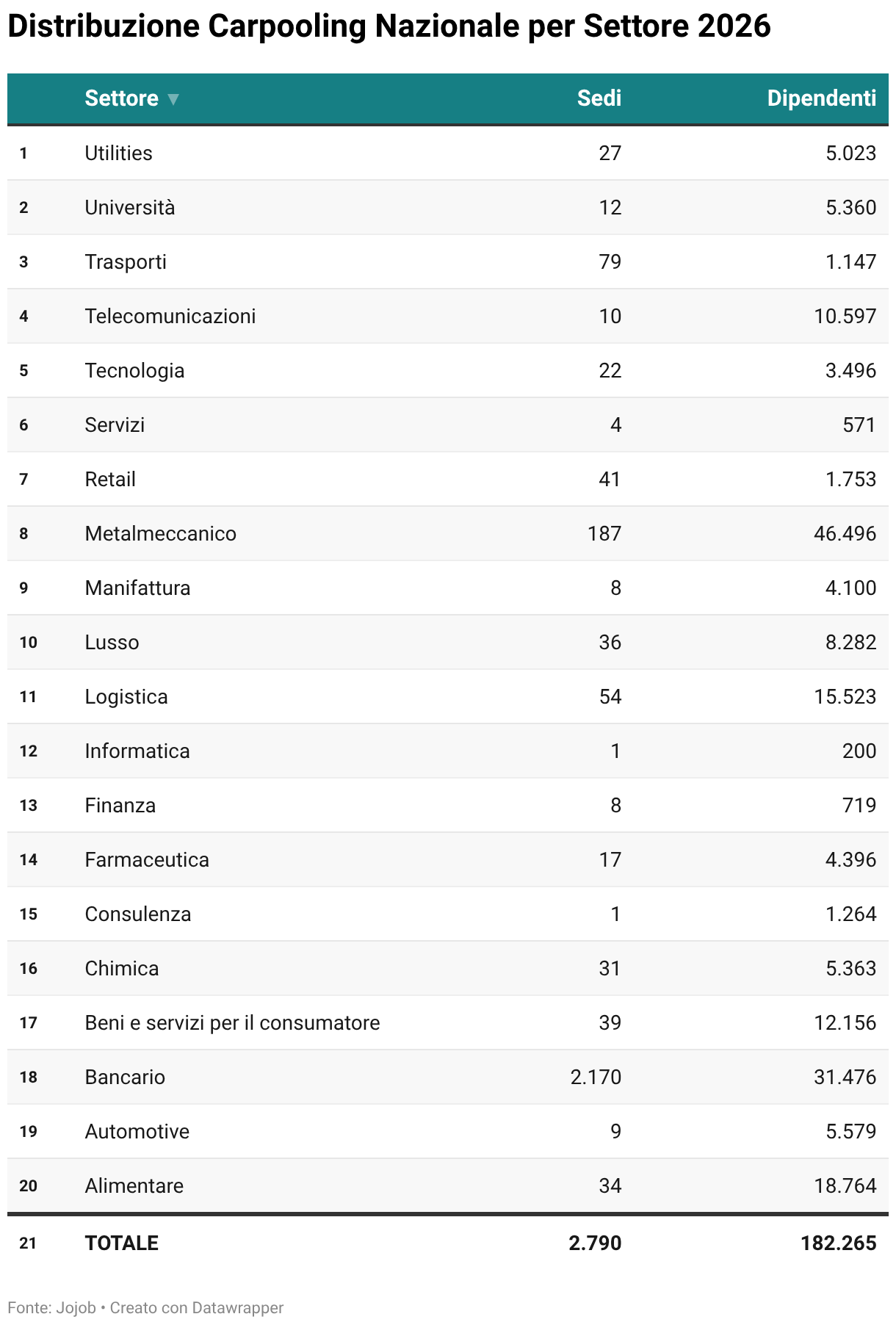
The distribution by sector makes visible the variety of organizations. The banking sector accounts for 2.170 locations, 77,8% of the total, but the figure mostly reflects the widespread coverage of branch networks: the surveyed banking organizations are 7 and involve 31.476 employees. The metalworking sector, on the other hand, has 187 locations, 13 organizations, and the largest employee potential, equal to 46.496 people.
Following, by number of locations, are transport (79), logistics (54), retail (41), consumer goods and services (39), luxury (36), food & beverage (34), chemicals (31), utilities (27), technology (22), and pharmaceuticals (17). The picture is completed by universities, telecommunications, automotive, manufacturing, finance, services, consulting, and IT. By number of employees, following metalworking and banking, food & beverage (18.764), logistics (15.523), consumer goods and services (12.156), and telecommunications (10.597) stand out.
The result is a network that does not depend on a single production model: Jojob can serve both organizations with a few large premises and entities distributed across hundreds of local points. It is precisely this flexibility that makes corporate carpooling a national lever, capable of integrating public action with the autonomous demand of companies.
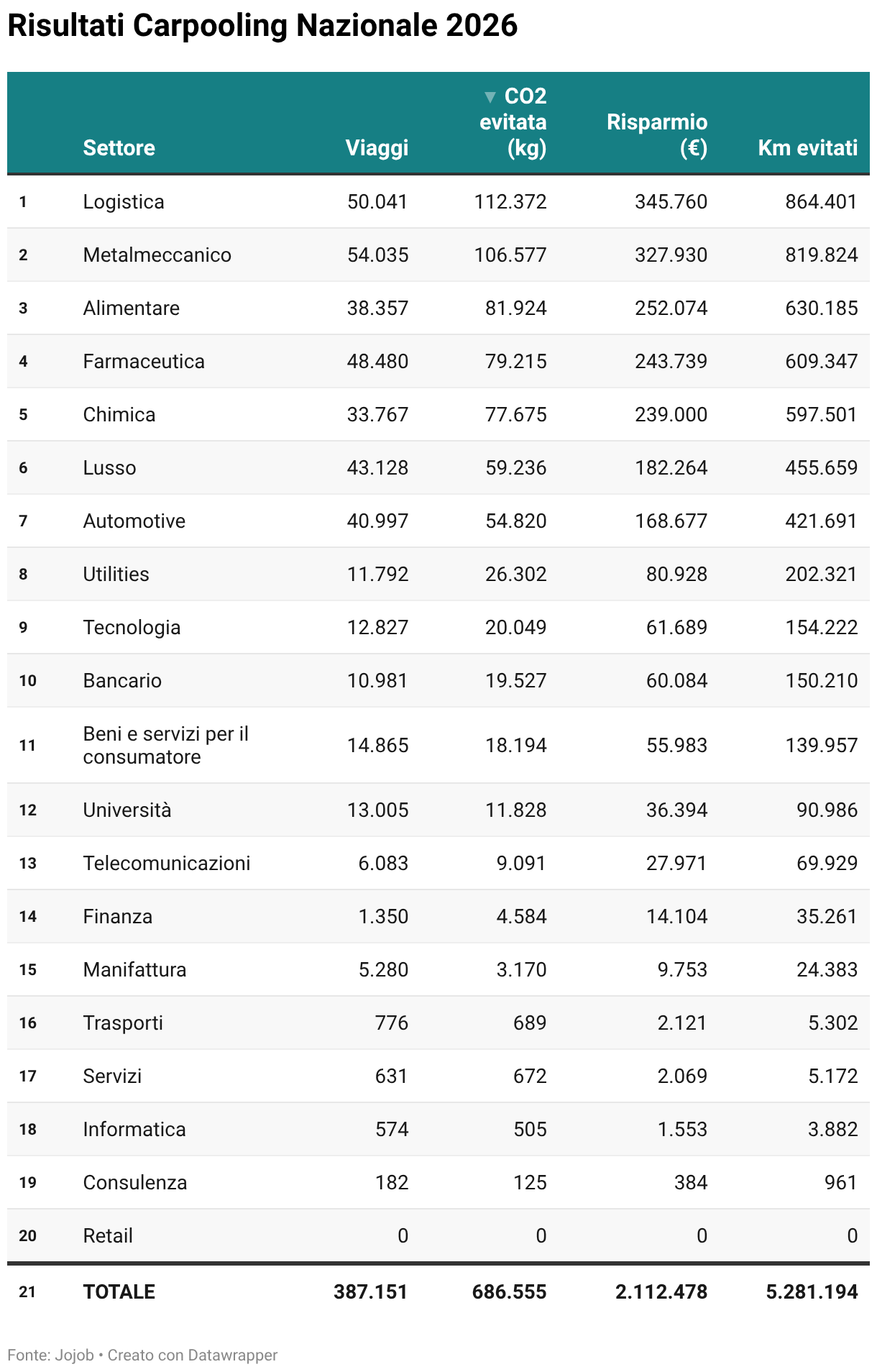
According to data from the Jojob Observatory 2026, corporate communities total 387.151 shared trips which, based on the Jojob methodology, correspond to over 5,28 million car-kilometers estimated as avoided, 686.555 kg of direct CO₂ emissions estimated as avoided – equal to about 686,6 tons – with total economic savings estimated at 2.112.477,54 euros.
In terms of number of trips, the metalworking sector leads with 54.035, logistics with 50.041, and pharmaceuticals with 48.480; followed by luxury (43.128), automotive (40.997), food & beverage (38.357), and chemicals (33.767). On the front of direct CO₂ emissions estimated as avoided, logistics reaches 112.372 kg, ahead of metalworking with 106.577 kg, food &beverage with 81.924 kg, pharmaceuticals with 79.215 kg, and chemicals with 77.675 kg.
Nearly 95.000 trips across the three territorial projects and a corporate presence reaching 2.790 sites demonstrate that carpooling can grow along two complementary lines: top-down, when an administration builds a public program; bottom-up, when companies directly organize their employees’ home-to-work mobility. Jojob connects these two forces and transforms them into a measurable, incentivizable, and replicable network.
In the Jojob model, national carpooling connects corporate and regional communities into a shared network, allowing people to find carpooling opportunities even beyond the boundaries of a single company or location.
Corporate carpooling is activated by companies to organize and incentivize shared home-to-work commutes for employees. Regional carpooling, on the other hand, involves a Municipality, a Metropolitan City, or multiple territories, and can include companies and people commuting within the area concerned. With Jojob, both modes can integrate into a shared national network.
Jojob connects people with compatible routes and schedules within corporate or regional communities. The platform certifies shared trips and collects aggregated route data, from which estimates of avoided car-kilometers and avoided direct CO₂ emissions are calculated. Where applicable, it also manages incentives according to the rules defined by the company or authority. Mobility Managers and administrations can monitor results through dashboards and reports, while users gain access to an already active national network.
Jojob processes estimates starting from certified shared trips tracked via the app. Certification is based on GPS tracking of both driver and passenger, verifying their simultaneous presence on board alongside anti-fraud controls. Estimated avoided car-kilometers correspond to the distance that, under the adopted reference baseline scenario, the passenger would have driven using a separate single-occupancy vehicle. Based on this distance, direct avoided CO₂ emissions and economic savings are estimated. The results are continuously updated and made available to users and participating organizations through dashboards and reporting tools.
Yes. A company can directly activate Jojob for its employees even in an area where no dedicated public project exists. The corporate community thus becomes part of the national Jojob network without depending on the rollout of a regional initiative.
Activating a Jojob community is simple. Jojob begins by analyzing the mobility needs of the company or territory and setting up a dedicated community that users can access via the Jojob app. It then supports the launch with communication and engagement initiatives, providing ongoing support along with tools to monitor participation and shared trips. Finally, using the Jojob methodology, it allows organizations to estimate and report avoided car-kilometers, economic savings, and direct avoided CO₂ emissions.
Discover how to activate a Jojob community, define the incentive model, and measure the impact of carpooling in your territory or company.

Sources:
INRIX 2025 Global Traffic Scorecard
La Nazione — Firenze, 51 ore perse nel traffico
Mole24 — Torino, 44 ore in coda
Legambiente — Mal’Aria di città 2026
Prima Brescia — concentrazioni annuali di NO2
MIMIT — Prezzi medi nazionali dei carburanti
Adnkronos — prezzi benzina e gasolio del 29 luglio 2026
Osservatorio clienti 2025–2026
ISTAT — materiali tematici sul traffico
Italia Sette — Firenze tra le prime 100 città per traffico
Torino Cronaca — Torino, 44 ore annue perse nel traffico
Legambiente — dossier Mal’Aria di città
Methodological note on environmental data
The values relating to estimated avoided car-kilometers and estimated direct avoided CO₂ emissions are estimates referring to certified shared trips tracked through the Jojob app. Overall corporate community data covers the first half of 2026; data for the Metropolitan City of Turin and the Brescia area projects cover the period from September 17, 2025 to June 30, 2026; for Florence, the period considered spans from June 30, 2024 to June 30, 2026.
A trip is certified through GPS tracking of the driver and passenger, verification of the concurrent presence of users on board, and specific anti-fraud checks.
The estimated avoided car-kilometers are calculated by attributing to the passenger the distance that, under the adopted baseline scenario, would have been traveled using a separate single-occupancy vehicle. The estimate does not assume that the shared car did not make the journey, but rather that the additional vehicle associated with the passenger was not driven.
The estimated direct avoided CO₂ emissions are calculated by multiplying the estimated avoided car-kilometers by an emission factor of 0.130 kg CO₂/km, sourced from FETRANS/ISPRA. The calculation strictly considers direct emissions associated with vehicle use in the reference scenario and does not constitute a full life-cycle assessment. Among other factors, it excludes vehicle manufacturing and maintenance, fuel or energy production and distribution, infrastructure, congestion effects, and potential changes in travel behavior.
The values are rounded and represent model-based estimates, not direct measurements or data certified by an independent third party. Different results may arise from adopting different emission factors, reference scenarios, or scopes.